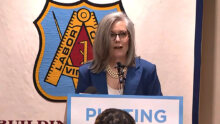


Winning an election usually brings a congratulatory phone call from the defeated candidate. In Ohio, however, Democrat Amy Acton has made it clear that one particular conversation is not going to happen.
The state's governor-elect says she has no intention of speaking with Republican Vivek Ramaswamy, even after he reportedly left her a voicemail congratulating her on her historic November 3 victory.
Acton's refusal comes after an extraordinarily bitter campaign in which Ramaswamy's team aired an advertisement featuring her estranged biological mother. The advertisement became one of the most controversial episodes of the gubernatorial contest because it brought Acton's painful childhood experiences into a statewide political fight.
On Friday, November 6, Acton addressed the issue during an appearance on CBS Mornings. She said she had no intention of speaking with Ramaswamy and emphasized that political leaders must be accountable for their words.
The response offered a revealing glimpse of how deeply the campaign had affected the incoming governor. It also showed that her victory had not erased the personal consequences of the contest.
The Advertisement That Changed the Race's Tone
During the final weeks of the campaign, Ramaswamy's political operation released an advertisement featuring Acton's estranged mother, Donna Arthur. In the commercial, Arthur accused her daughter of dishonesty and urged Ohio voters not to elect her.
What made the advertisement particularly controversial was the family's history. Acton has spoken publicly about experiencing severe abuse during her childhood, including sexual abuse by her stepfather. She was removed from her mother's custody when she was young.
By placing her estranged mother in a political advertisement, Ramaswamy's campaign turned an intensely personal family relationship into a campaign weapon. Acton condemned the decision, arguing that her opponent had exploited her childhood trauma.
Her brother also publicly criticized the advertisement and defended her account of the abuse. The controversy attracted attention beyond Ohio. Some Republicans joined Democrats in criticizing the advertisement, while President Donald Trump and Vice President JD Vance defended it.
That disagreement turned the ad into a national debate about the limits of political campaigning. Attack advertisements are common in American elections. Candidates routinely challenge their opponents' judgment, professional qualifications and political records.
But bringing an opponent's childhood abuse into the campaign raises a different set of ethical questions. An elected official's personal history can be relevant when it relates to claims made publicly. That does not mean every painful experience should become material for political advertising. The distinction became central to Acton's response.
Ohio Voters Delivered a Historic Result
Acton's victory was significant even without the controversy. She became the first woman elected governor of Ohio, defeating Ramaswamy in a year when Democrats made unexpected gains across several traditionally Republican states.
Ohio had moved decisively toward Republicans in recent presidential elections, making the result an important warning for the national GOP. Ramaswamy entered the race with a high national profile, considerable personal wealth and connections to Trump-aligned political networks. Those advantages ultimately failed to deliver the governor's mansion.
Acton, a physician and former Ohio health director, presented herself as a candidate focused on public service and practical problems rather than constant ideological confrontation. The contrast between the candidates' political styles became increasingly visible as the race grew more contentious.
After winning, Acton argued that voters had grown tired of division and wanted elected officials to concentrate on solving problems. Her refusal to engage with Ramaswamy can be understood within that broader message.
She is not saying political opponents should never communicate. She is saying she does not believe she owes a personal conversation to someone whose campaign, in her view, crossed a fundamental boundary.
Victory Does Not Require Personal Reconciliation
There is a difference between accepting an election result and repairing a personal relationship. Ramaswamy's reported voicemail represented a conventional gesture following an electoral defeat. Acton's response suggests that convention alone is not enough.
Some observers may consider it important for the incoming governor to model reconciliation. Others will see her decision as a reasonable refusal to normalize what she regards as unacceptable campaign conduct. Those interpretations are not necessarily contradictory.
Acton will still be responsible for governing a politically divided state, including residents who supported Ramaswamy. Her public disagreement with him does not prevent her from working with Republican lawmakers or representing voters who opposed her candidacy.
The larger challenge is translating her message about decency into the everyday compromises required by state government. That will be considerably more difficult than delivering a victory speech.
For Ramaswamy, the controversy may also have lasting political consequences. He remains a nationally recognized Republican figure, but the advertisement will likely be revisited whenever his judgment and political ambitions are evaluated.
For Acton, the election delivered two victories: control of the governor's office and the opportunity to define her political identity beyond the attacks directed at her. She has made clear that she does not intend to give her defeated opponent another opportunity to define the conversation. At least for now, his congratulatory call will go unanswered.