


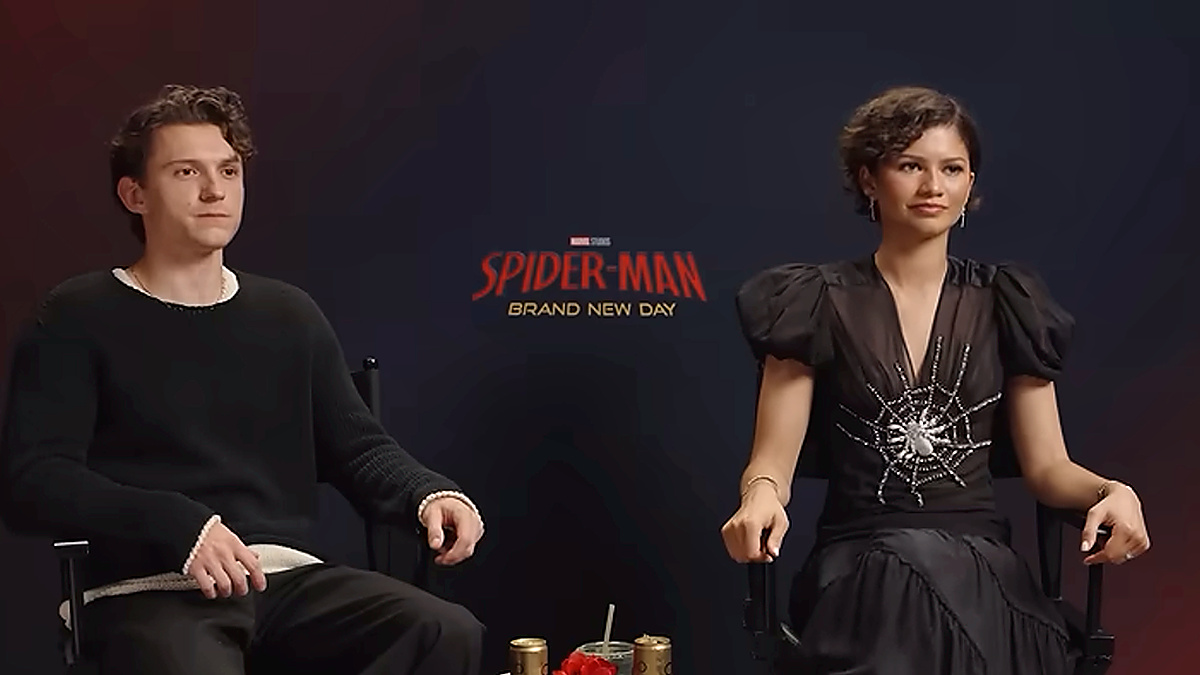
The public knew Zendaya and Tom Holland as co-stars long before it knew anything reliable about their private life. That distinction matters. Their relationship grew against the background of the Spider-Man franchise, a series whose promotional machinery invites audiences to treat the chemistry between characters as a clue about the actors who play them. Yet the two performers have consistently demonstrated that an audience can enjoy their work without possessing every detail of their relationship.
Now that Holland has publicly confirmed their marriage, the central story is not the mystery of whether there was a wedding. It is how two globally recognizable actors managed to protect the occasion from the machinery that turns celebrity milestones into public spectacles. Their approach amounts to a useful challenge to one of Hollywood’s most persistent assumptions: that fame creates an obligation to share.
A romance that developed under a franchise spotlight
The actors became widely associated through the Spider-Man films, with Holland playing Peter Parker and Zendaya portraying MJ. The franchise’s enormous reach created an almost unavoidable audience interest in their off-screen rapport. Social media, fan accounts and entertainment coverage quickly turned casual public appearances into material for theories about what was happening privately.
The distinction between curiosity and entitlement was tested in 2021, when photographs of the couple kissing appeared in the press. They had not chosen that moment as a public announcement. In a subsequent interview with GQ, Holland described the difficulty of having a private experience become a worldwide conversation. He also made clear that any account of their relationship should be something they told together, not something he could narrate on her behalf.
Zendaya similarly framed affection as something with private dimensions, even when the people involved work in a business built around visibility. What made those comments unusual was their refusal to frame privacy as a hostile response to fans. Neither actor was arguing against public interest in their professional lives. They were drawing a boundary around the human relationship behind that interest.
The wedding changed the facts, not the principle
By June 2026, the question of whether the couple had married was settled by Holland himself. In coverage of his interview with Esquire U.K., the Los Angeles Times reported that Holland confirmed the marriage while withholding most details of the private celebration. That is an important editorial distinction: a confirmed marriage is a fact; an elaborate reconstructed ceremony assembled from speculation is not.
The celebrity economy often treats a wedding as a product launch. There are first-look photographs, designer-credit stories, seating-chart speculation and a secondary wave of social posts designed to keep the event circulating. None of these is inherently wrong when a couple chooses them. The difficulty begins when silence gets interpreted as a gap for outsiders to fill.
Holland and Zendaya have offered a different arrangement. They can acknowledge the relationship’s reality and importance while leaving the guest list, private vows and family memories outside public ownership. Their decision does not make them less interesting. It gives the story a sharper subject: two actors exercising control over information about their own lives.
Why the pressure is different for two working stars
A celebrity couple can be reduced to a joint brand even when each partner has a substantial independent career. Zendaya has built a body of work extending from television to major films and fashion campaigns. Holland has moved between franchise filmmaking and other performance projects. Those careers are sufficiently significant that treating the marriage as either person’s defining achievement would be a distortion.
The pressures are also asymmetric. Clothing, jewelry and expressions are scrutinized for supposed relationship messages; one person’s professional schedule becomes an alleged clue about the other person’s emotional state. A red-carpet appearance can create several rounds of coverage before anyone has said a word. Silence, in such an environment, is often misread as trouble.
Their long-running approach demonstrates why that reading is unreliable. Refusing to discuss a topic at length does not establish that something is wrong. It may simply establish that the speakers are selective about what they owe a microphone. A healthy celebrity-news culture has room for that difference.
Fans can follow the story without owning it
There is still legitimate material to cover: the actors’ public comments, their collaborations, their confirmed appearances and the way their careers intersect. Readers can also reasonably be curious about why two actors with enormous audiences would choose a largely private ceremony. What journalism cannot responsibly do is convert that curiosity into invented details or pretend that every unconfirmed rumor deserves equal billing with a direct statement.
A more satisfying interpretation starts with the facts the couple has actually shared. In 2021 they spoke about a loss of privacy and the wish to tell their story together. In 2026 Holland confirmed their marriage, while again declining to turn everything surrounding it into public content. These moments are consistent rather than contradictory.
For a couple watched by millions, restraint may be one of the clearest expressions of agency. They have not rejected the audience that helped make their careers possible. They have demonstrated that being visible at work and being available in every private moment are two different things.
The bigger lesson of their relationship
The enduring appeal of Zendaya and Tom Holland is not that they supplied every detail of a romance on demand. It is that audiences saw an apparent contradiction hold together: a relationship that the public recognized but could not entirely access. That has become rarer as celebrity culture increasingly rewards constant disclosure.
If their marriage becomes an enduring reference point in entertainment coverage, it should not be because outsiders finally solved a puzzle. It should be because the pair managed, across several years of extraordinary attention, to keep some meaningful decisions theirs. In a celebrity world that can confuse intimacy with content, that is a genuinely distinctive story.
Sources and further reading
- GQ: Tom Holland on fame, Zendaya and privacy (2021)
- Los Angeles Times: Holland confirms the marriage (June 2026)
Comments (0)